Natural Dyeing from the Greengrocer

Artistic inspiration, always an elusive commodity for me, has left the building over the past week.  It’s rainy and cold: it’s soup weather here in Western Australia.

So my inner Earth Mother must have kicked in.  Why not add a few things from the greengrocer into the basket?  That way, you can dye yarn in the kitchen rather than in the windy outdoors.

IMG_8820

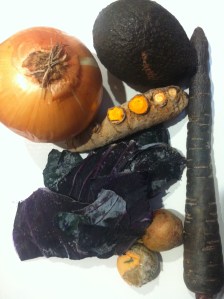
Brown onion, avocado, turmeric tuber, purple cabbage, avocado pips and a purple carrot.

Dyeing with vegetables is a lot easier if the plant matter is cut as small as possible.  I know that those of us who own Thermomix appliances are regarded as wealthy and gullible dilettantes but, hey, they are useful when you want to make your turmeric tuber /purple cabbage/purple carrot yield as much dye as possible.  It’s all about surface area exposed to water, right?

[I realise, reading this again, that I have merely fed the poor reputation of Thermomix owners!]

Of course, when you have finely minced plant material as your dye medium you really need to keep it from getting into your fabric and yarn.  Voilà. Enclose it in silk and you keep the dyed fibres clean while giving yourself some lovely pieces of fabric.

IMG_8804

Top to bottom: Purple carrot, avocado pips and turmeric on silk

To keep the whole indoors process safe, I decided not to try any mordanting.  I just lowered the yarn skeins into the pot containing a silk-wrapped bundle of the vegetable concerned, brought it to simmer, turned the temperature down and maintained it at around 60 degrees centigrade for at least 30 minutes.  In some cases I left the whole pot to cool to room temperature overnight.

I raided my stash of undyed, white or cream natural fibres (that is, silks, cottons, wools, kid mohair) and made small skeins from them.

The results are pleasing to me.  They are not spectacular.  Nor should they be.  The thing about natural dyeing for me is that the colours are soft and, yes, natural.  They seem to play well with one another somehow.  Because I use small quantities of both fabric and yarn in my work I relish small variations. I don’t want to produce metres at a time of the one dye lot. Each small batch of dye produces a slightly different outcome, even with the same fibre.  Obviously, that’s because the amount of dye material in the pot varies, the amount of pigment in a particular plant varies with season, etc.

IMG_8808

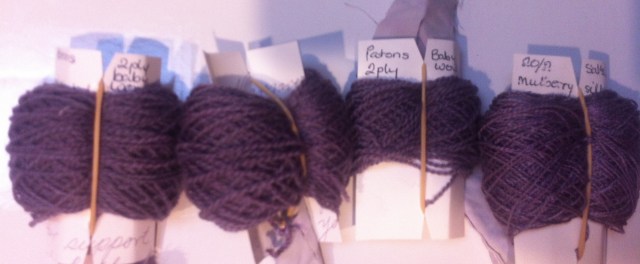
Left to Right: Wool; Patons baby wool; mulberry silk; and cotton yarns dyed in grated turmeric

IMG_8810

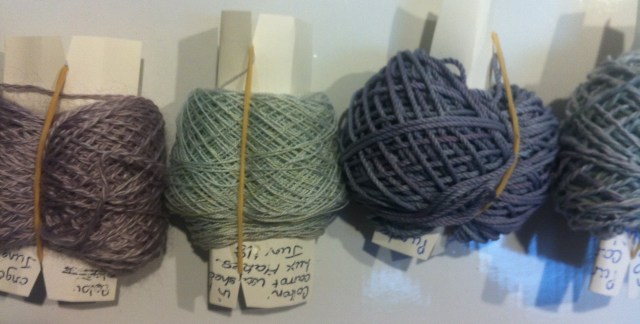
Three balls on the left are all Patons 2 ply baby wool and far right is 20/2 mulberry silk, all dyed in purple carrot


IMG_8813

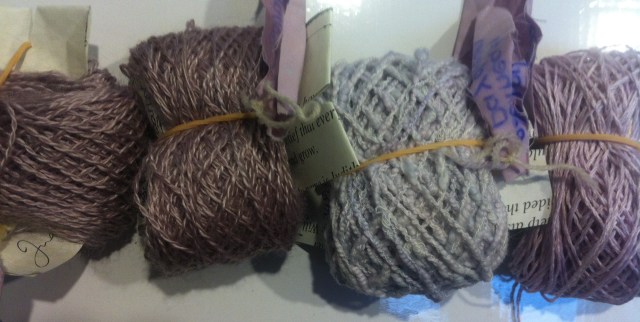
Left to Right: Kid mohair, cotton, silk cord. cotton dyed in purple carrot

IMG_8815

Left to Right: kid mohair; kid mohair; 60% cotton with acrylic and polyester; and 100% linen dyed in purple carrot

IMG_8818

Clockwise from top left: cotton thread; linen thread, kid mohair, 60% cotton with acrylic and polyester, silk cord, and chunky cotton thread dyed in avocado pips.

Enter a caption

IMG_8819

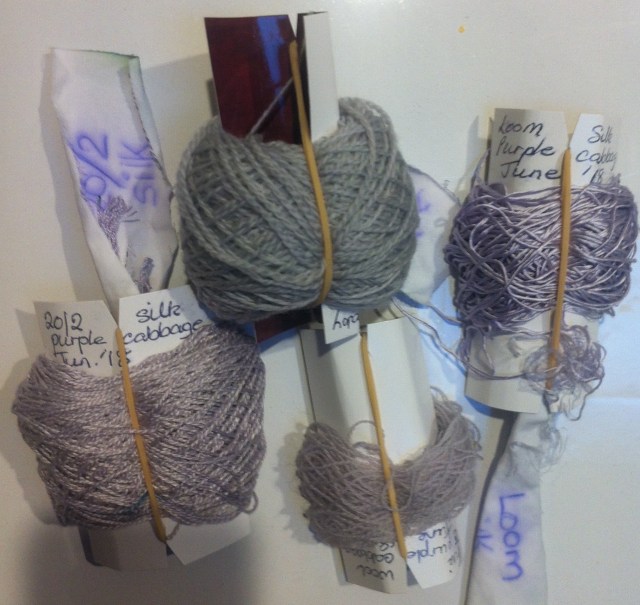
From left to right: 20/2 silk; Patons 2ply baby wool; fine wool; and silk fibre from Loom in Bangkok dyed in purple cabbage

Natural dyeing onion - 1

Clockwise from top left: 20/2 silk; kid mohair; fine wool yarn; and perle #8 cotton, all dyed in brown onion leaves.  Leaf crocheted in 20/2 silk.


Now I just have to find that artistic inspiration that has been eluding me.  These yarns deserve that!


Posted in brown onion as dye, Natural dyeing, purple cabbage as dye, purple carrot as dye, Turmeric as dye, turmeric tuber as dye | 3 Comments

Yarn Dyeing: Buyer Beware

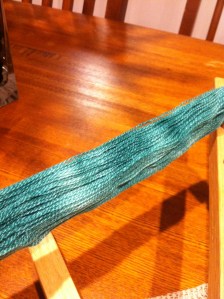
Last weekend I went to a fibre fair in a rural town.  Although i love dyeing my own yarns, especially with plants, I couldn’t resist buying some skeins of 70:30 merino:silk yarn dyed by hand by the seller with  what was described as “an eco-friendly acid dye”. [I have not researched this since the dyer could not recall the name of the product (!) and I’m guessing I might be disappointed at what I found – but then, I’m cynical]


IMG_8801

The pink skein with its blemish where too tightly tied


IMG_8795

The green skein also had a blemish

On this occasion I am not worried because I work small and quite like variations in any case. However, it would annoy me if I had bought the yarn for a garment!

The lesson here is to look closely at the skeins before buying them unless you know the product and can be sure that it’s been dyed correctly.

IMG_8797

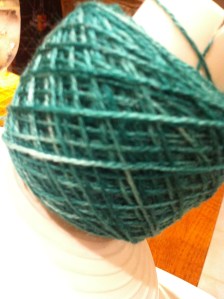
The green skein when balled

Posted in Uncategorized | Leave a comment

Blue/citrus scarf

A month since my last blog and there’s not much to report.  Stash-busting has sat alongside stash acquisitions, unfortunately. The Stitch and Craft Fair here in Perth was a great and unresisted temptation as Prudence Mapstone came over with a gorgeous collection of yarns.

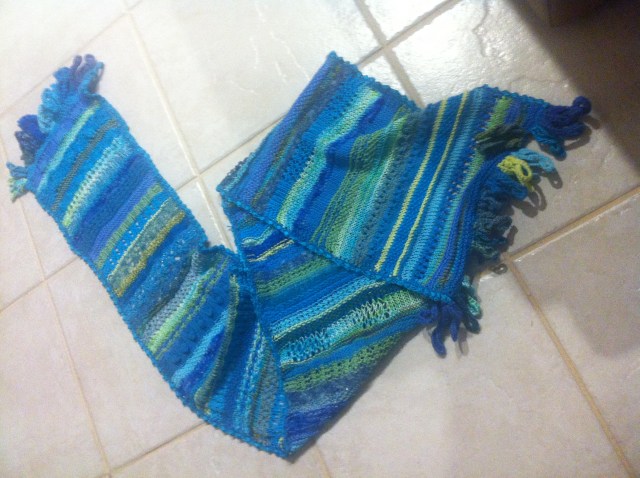
However, before the month of May ends I thought I should just post some images of another scarf.  It’s not one I’ll wear as it’s not my colours but it did use a bit of the wonderful collection of silks in my drawers…..

Again I used the scarf as an exercise in expanding my knowledge of different knit stitches.  Although the thickness of the yarns varied I used the same needles throughout and just varied the tension.

To give weight to the ends I used thicker yarns to crochet a fringe.  I hate it when my scarf flies over my shoulder in a wind.

The whole scarf…..


IMG_8789

I have been dyeing yarns with plant dyes for an upcoming  fibre festival in Toodyay.  They are considerably less colourful but have a subtle charm of their own so I will post something about them next….

Posted in Clothing, freeform knitting, Knitting, Scarf | 1 Comment

Red-Orange Scarf

Yarn stash-busting is required.  The red yarns in particular have outgrown their drawers and baskets.  I got them together.  Well possibly not all of them; there is always the likelihood of finding a colony that has established itself elsewhere in the house. However, for my purpose there were enough in front of me.

Red-orange scarf - 1 (11)

The yarns varied in weight; from 8 ply (sports or DK) to everything below that, including embroidery weight threads. Wool, angora, silk, cotton, silk ribbon,  mohair and mixtures of all these were in there as well.

As a break from freeform knitting and crochet I decided to go simple; to do something I could watch TV or DVDs doing.  Conventional knitting was the answer. However, I also wanted to make stitches I had not made before, as a way of increasing the interest of the piece.  So a kind of sampler scarf came to mind. Throw in the constraint of using only one pair of needles and that added a challenge because, of course, combinations of yarn would be needed to ensure that the tension/gauge remained the same so the width of the scarf didn’t go in and out like a snake after swallowing a wallaby.


Snake swallowing wallaby

Satisfying wallaby meal for the snake but an unattractive profile for a scarf

Long story short, I then spent several evenings choosing yarns and stitches and building the scarf.  I wanted to master some simple patterns that I could deploy elsewhere,  I used two of my favourite knitting resources, besides my own brain:

Mary Walker Phillips , Creative Knitting A New Art Form (New & Expanded Edition), Patricia Abrahamian (ed.), Dover Publications, New York, 2013;

Phillips Creative knittingand

Nicky Epstein, Knitting Over The Edge, Sixth&Spring Books, 2005.

Epstein Knitting over the edge

A small section of the project:

.Red-orange scarf - 1 (6)

One of my most valuable discoveries was of a way of making a double-walled stitch that resulted in a tube.  I had been wanting to give some weight to the ends of the scarf so it sat without drifting in the breeze and with movement.  On the other hand the weight needed to be moderated- too heavy and the scarf would look “dragged down”.

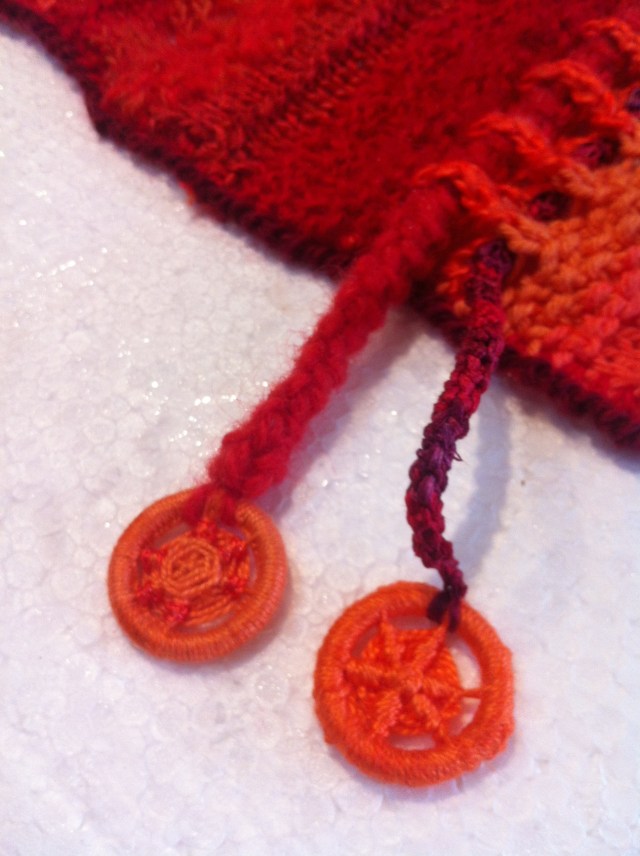
On one end I made such a tube and threaded it with a braid of Romanian lace done in 3D to which I attached two Dorset buttons on each side.  This added weight without “drag”..

Red-orange scarf - 1 (7)

End of scarf featuring double walled channel threaded with two 3d Romanian lace braids and two Dorset buttons.  The other side of the scarf was finished in a similar way, albeit with different-looking Dorset buttons.


Red-orange scarf - 1

At the other end of the scarf I threaded two 3D Romanian braids through a ribbed eyelet section and attached Dorset buttons to each of the four ends.


Red-orange scarf - 1 (1)
The finished scarf being blocked.

The scarf as worn….


Posted in Clothing, Design, Knitting, Scarf | 4 Comments

Textile Study Trip to China’s Guizhou Province: Part 2

On Sunday 18 Feb 2018, the second day of our textile adventure in China’s Guizhou province, we checked out of the Trade Point Hotel in Guiyang and began making our way by road via Leishan to Xiao Danjiang to see a festival of the Long Skirt Miao.

Lunch in Leishan was a good introduction to a small town in a rural Chinese province with no  tourist profile. The New Year holiday had the effect of making the town seem very quiet.  I don’t think that we could  have ordered food without the aid of our interpreter.  Even with pointing and miming (skills we  acquired progressively during the trip) there was no menu,  and short of tasting the  food of the smiling local Miao language speaking people at adjacent tables, we would not have known what was available.  Mind you, these fellow guests were very kind and welcoming.  When our guide confided to one couple that I had seen an article on the internet in Perth about fermented vegetables being a staple part of the local diet, they immediately insisted that I help myself from their bowls.  While I did on subsequent days taste some very flavoursome fermented dishes, this first one was just a tad TOO fermented for me to cope with.  Until then I’d assumed that our table was located a little too closely to the rubbish bins but the smell proved to be from fermentation of a deliberate kind.  Our  guide was also key in the finding of toilets.  Often they are illusive and of course we did not have the local words to ask about them.


China Leishan - 1 (2)

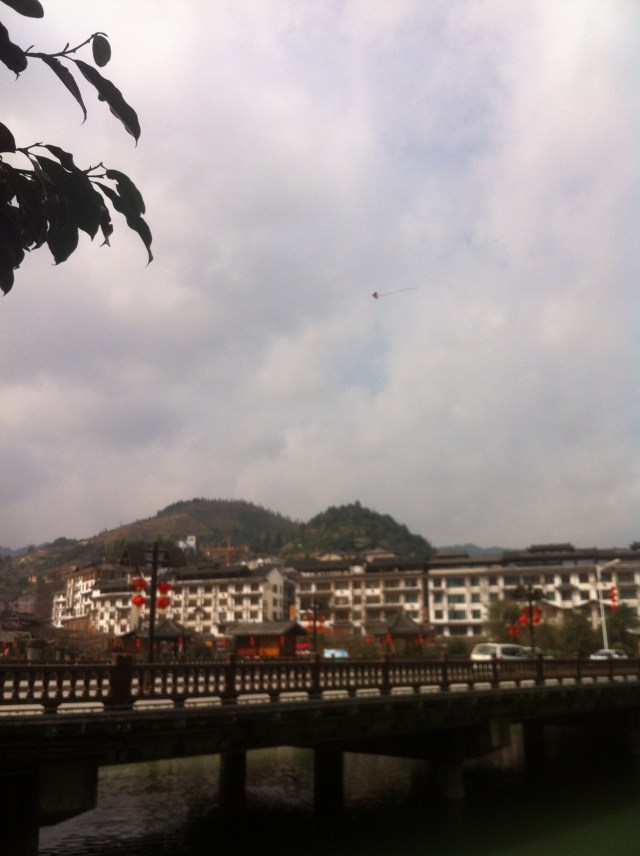
The view from our waterside seating in Leishan across to village landmarks.

China Leishan - 1 (1)

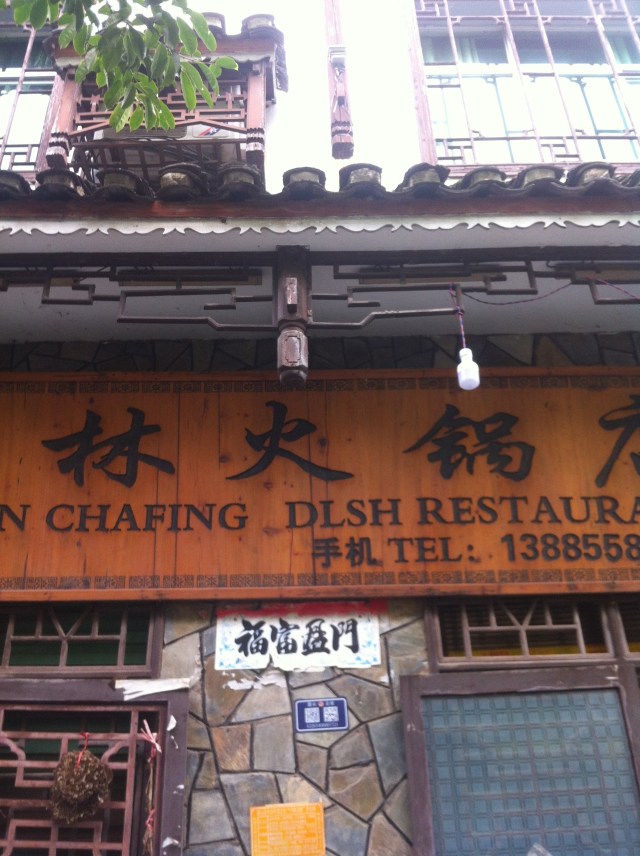
An amusing mis-translation of Chafing Dish.The restaurant looked quite interesting but was closed for the New Year holiday.


IMG_7508

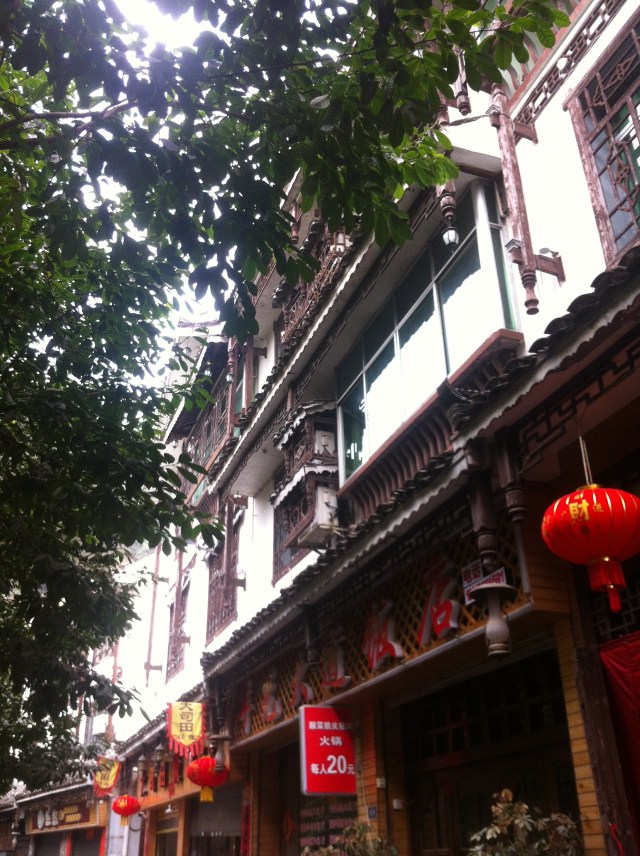
I loved the way the modern air-conditioners were concealed by traditional wooden fretwork (just above the sign saying 20 Yuan). 

China Leishan - 1 (3)

Ever-present mountains in Guizhou.  They say that in Guizhou Province “there are no three hectares without a mountain”.  To me that seemed an under-statement.

China Leishan - 1 (4)

I loved the textures in the bridge posts

China Leishan - 1 (6)

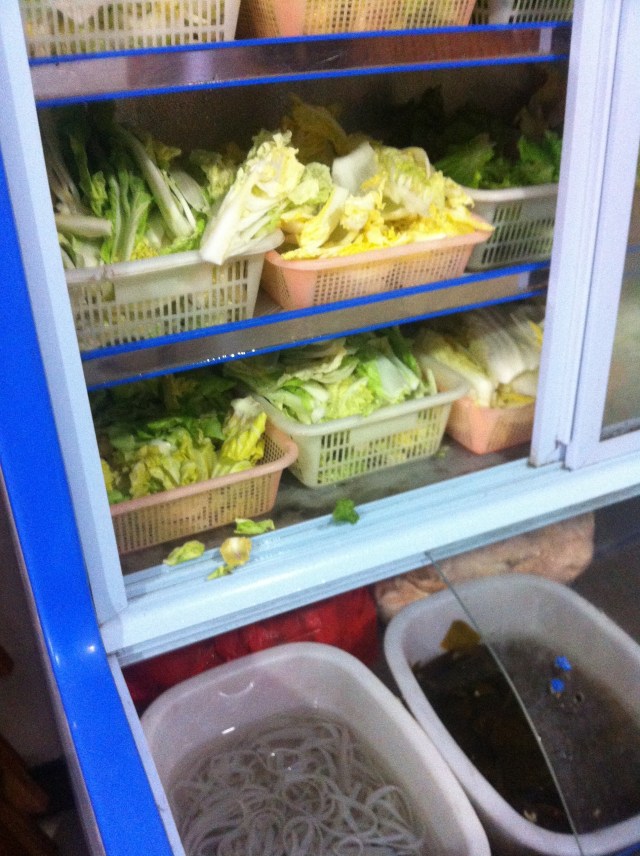
The main cafe offering is hotpot.  So you need to select your greens and your noodles.  Here is the “pantry”.  Grab a basin and fill it from this smorgasbord of refrigerated and very clean inputs. The dark material on the right of the noodles is seaweed.

China Leishan - 1 (5)

We picked an outside restaurant. As a guide to scale, the gas bottle is ordinary (western) size.    The stools and table are very low – but standard for the province.  One has to land one’s bottom carefully or one flips backwards in a very undignified heap.  It happened!


China Leishan - 1 (7)

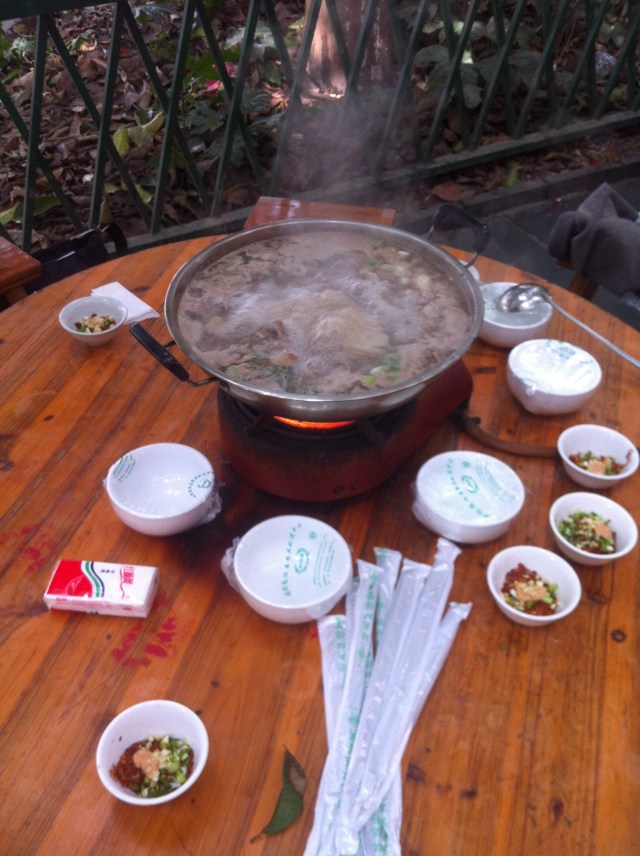
Everyone gets a bowl of “seasonings” for their hotpot helpings. Chilli, spring onions, and a fermented vegetable paste. The packet is the ubiquitous Chinese serviette: a packet of tissues dropped onto the table as you take your seat. The other packets contain chopsticks. 

China Leishan - 1 (8)

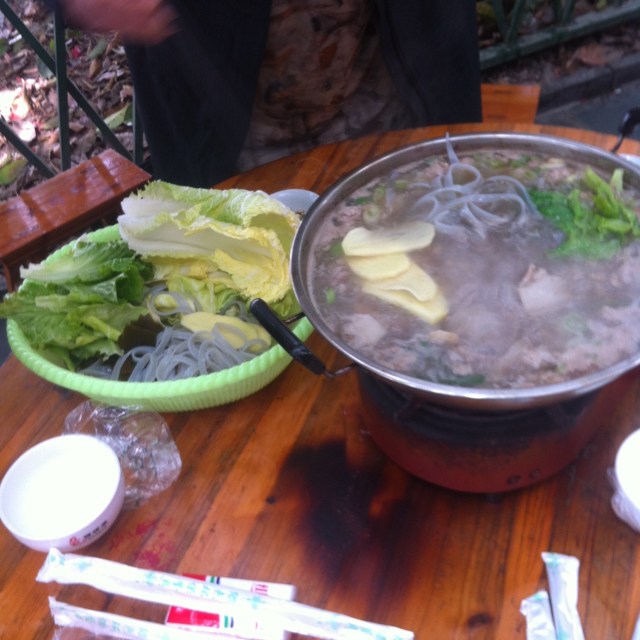
Our hotpot on the boil. Gas powered ring. Small bowls contain individual seasonings .  Larger bowls for food are covered in plastic until required, as a guarantee of cleanliness. Small packet contains tissues aka serviettes.

China Leishan - 1 (9)

The lovely street location of our lunch destination. Judy is emerging from the shop with a selection of greens for the hotpot. The rice is suitably accessible, if not exactly hygenically presented.


China Leishan - 1 (10)

It’s all go now. Sliced potato, onions, noodles, seaweed and greens in the hotpot. Bowls freed of their plastic. Chopsticks yet to be unwrapped. Plenty more greens to add to the pot…..meals are generally high on vegetable and carbohydrates and low on protein, although there is sometimes some fresh or fermented tofu (the latter translated as “mildewed tofu” by our guide).  And, yes, cooked lettuce IS indeed very floppy and difficult wrangle elegantly into the mouth .While our guide bought us some forks and spoons after seeing some of us struggling with chopsticks on the first night, we often  forgot to take them from the car and thus rapidly had to improve our chopstick techniques.

China Leishan - 1

Looking up from the hotpot to the building details above….while those with urgent needs picked their way to a toilet down an alley way before we moved on to our first festival of the trip…..

Posted in Eating rural Chinese food, Guizhou in South -West China, Textile tour to China | Leave a comment

Textile Study Trip to China’s Guizhou Province: Part 1


This is the first of several posts intended mainly for my own benefit as a record of a wonderful trip from Perth to Guizhou in China from 17 – 28 February 2018. The capital of Guizhou province is Guiyang.


China province and major cities map chinamap

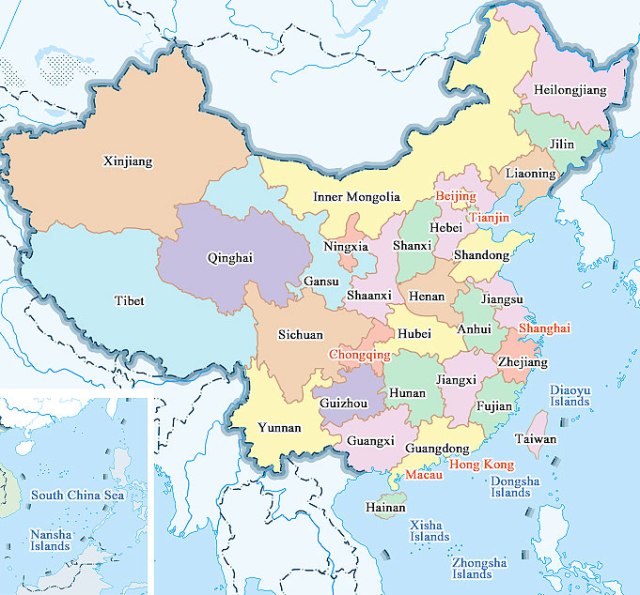
Map showing China’s provinces (black) and major cities (red).  Note how far Guizhou (lower centre in mauve) is from Beijing and Shanghai.


Last year I was lucky enough to register quickly for, and be accepted into, a small group tour of Guizhou Province, north of Guangzhou in Guangdong Province.  Dates were 17-27 February 2018.

Arranged by Gail Hawes of Soulful Stitches (https://www.soulfulstitches.com.au),  its purpose was to study the traditional textiles of the region, specifically the traditional embroidered costumes of some of the region’s many Chinese minority groups (that is, non-Han Chinese communities). We would attend village-level Chinese New Year festivals and visits to the studios and homes of clan embroidery masters.  Just four of us plus Gail, a guide (Mr Lee) and a driver, explored several remote areas of Guizhou occupied by minority hill tribes of Miao and Dong people.  The trip took place during the Chinese New Year period,   concentrated on 15- 19 February 2018, so there were pluses and minuses.  The plus for us of course was all the New Year festivals in the province.  The negative?  Unusually crowded roads and many shops closed because their owners were travelling back to their home villages as required by New Year protocols.

20180217_000055

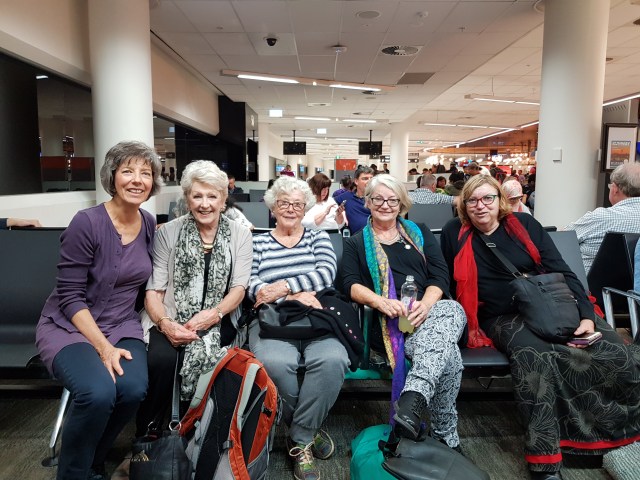
Left to right: Gail; Janet; Judy; me; and Jennie.  Bright -eyed and ready to tackle anything Guizhou can throw at us! Photo: Gail Hawes via amenable fellow traveller.

On Saturday at 12.15pm on 17 February 2018 we arrived at Baiyun International Airport in Guangzhou,via Singapore,  after leaving Perth just after 1am. We transferred to a local airline for a flight to Guiyang, arriving in Guiyang at 5.30pm.  That last flight was notable for the fact that we had to empty our luggage of all batteries and chargers.  I normally put my laptop and my laptop and mobile phone chargers, etc, in my checked luggage but on this leg its was forbidden.  I removed mine (necessitating unlocking suitcase, and stowing these items in carry on luggage) but at least one in the group did not.  On arrival in Guiyang her suitcase was found to have been unlocked and a note left to say she had infringed the rules.  Coincidentally, the lock was missing, as was a necklace.

Our guide, Mr Lee, met us with his comfortable seven seater car and took us to the Trade Point Hotel for the night. The rooms were non-smoking ones but nobody told the previous guests or the people doing the laundry.  In due course I learned to live with that.


IMG_7487

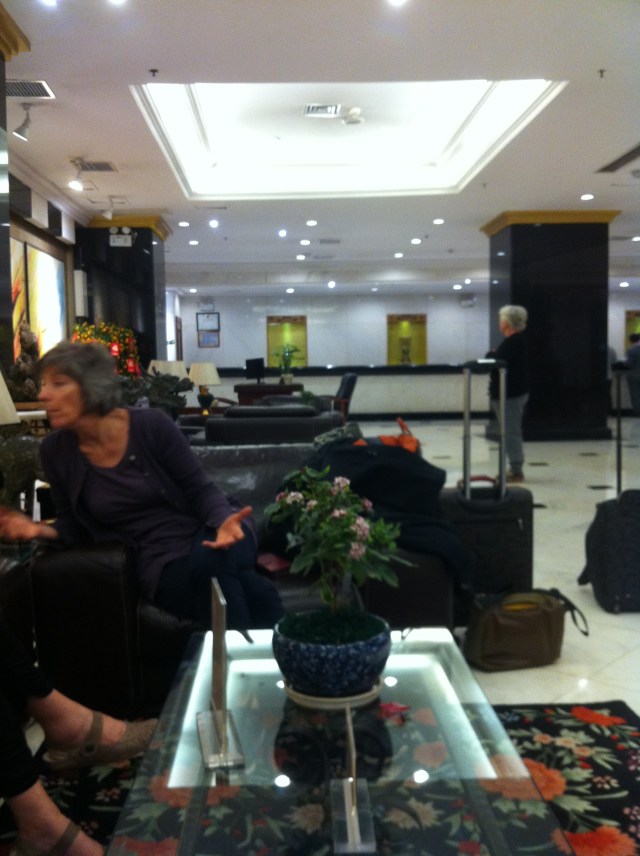
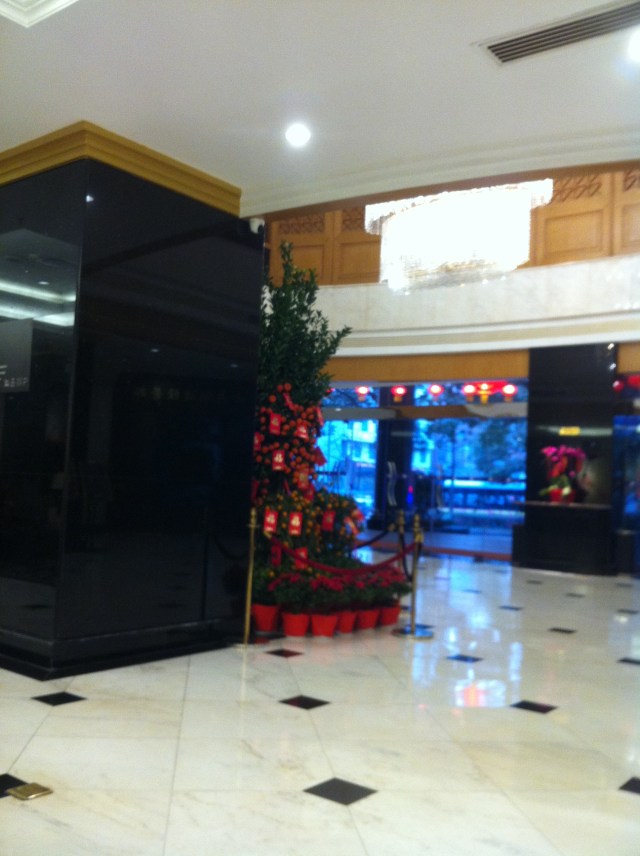
Gail talking to Janet in the foyer of the Trade Point Hotel in Guiyang while guide Mr Lee checked us in.  Judy is in the background checking the wall art.

IMG_7488

For the Chinese New Year celebrations the foyer was filled with real miniature mandarin trees covered with fruit


IMG_7489

Detail of the beautiful foyer rugs: a foretaste of the richness to come

IMG_7490

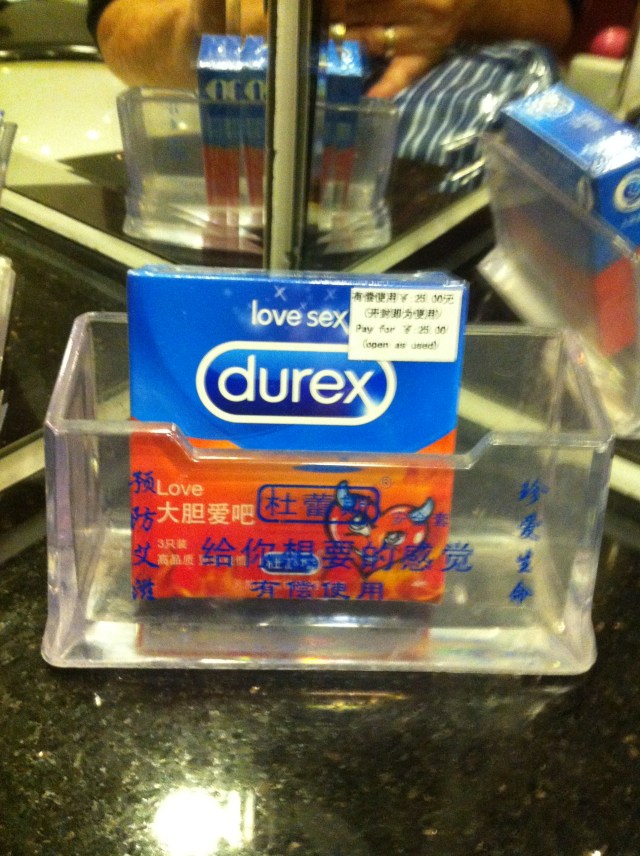
This hotel offers more than complimentary toothbrushes and shampoo!


IMG_7491

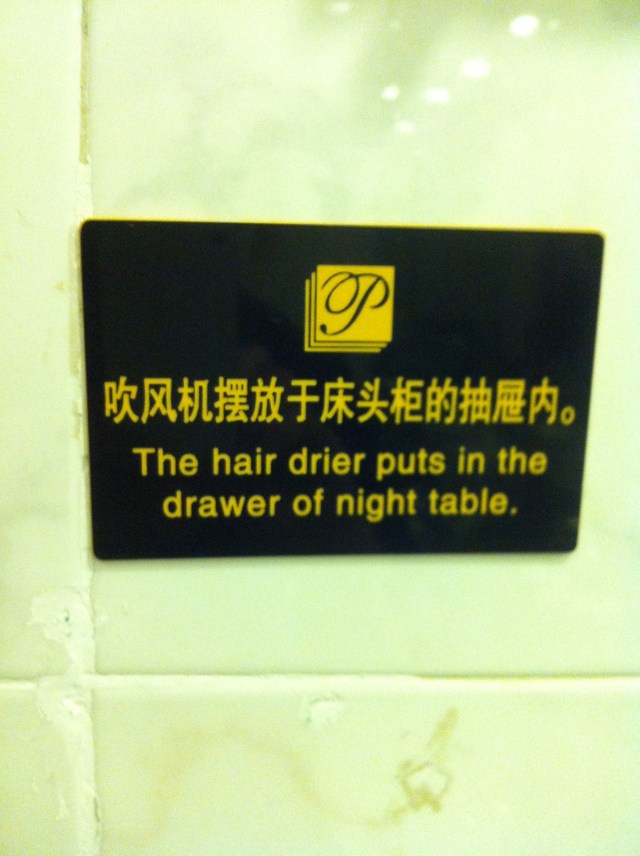
Helpful guidance

After checking in we had our very first meal in Guizhou.

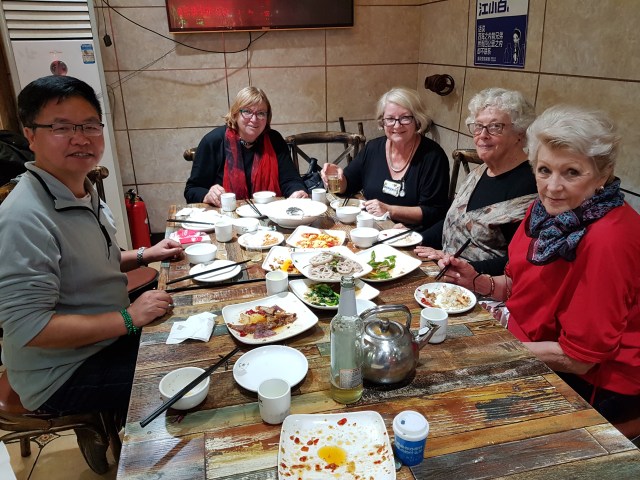
Dinner in Guiyang

Left to right: Mr Lee (our guide), Jennie, me, Judy and Janet. We quickly upgraded our chopstick skills and enjoyed the chilli and the Chinese tea.  Photo: Gail Hawes.


Posted in Eating rural Chinese food, Embroidery traditions of the Miao and Dong people of Guizhou province, Guizhou in South -West China, Hand embroidery, Textile tour to China | Tagged , , | Leave a comment

Christmas gifts

Somehow the year is coming to a rapid end.  Especially as I plan  an overseas trip for the first three weeks of December!

I don’t usually inflict my manipulations on people but this year I thought, probably in error, that it might be timely to send some hand made things to some of my young relatives. Specifically brooches, although every one of them can be pinned onto a ribbon for around a neck or converted to a hair ornament.

Starting a few days ago, my efforts were given a bit of drive by the televised Ashes (Australia v England) Test which is one of the very few television watching experience I am interested in….

So, here’s the start and here are some of the results that will be wrapped and sent off to unsuspecting recipients this Christmas…

IMG_6710

Now I just have to pack away the yarn left over…….. 

Posted in Crocheted brooches, freeform crocheting | Leave a comment

Exhibition Opening 3: Catering- What Works?

The Story So Far

Recapping the two previous blogs on this topic: serve  6-8 clean and tiny things per person over two hours.

Inclusiveness

It’s time to think about vegetarians, vegans, coeliacs, dairy intolerances, and whatever else manifests itself in a typical gallery gathering.

I am not a vegetarian but I always think that vegetable hors d’oeuvres are safer to serve than non-vegetable ones. I’ve never met anyone who was not able to eat a vegetable only nibble!

Bear in mind also that your servers will probably not be professionally qualified wait staff.   As such, plating up a range of exotic offerings that they either can’t pronounce or have never heard of will result in unhappy guests who don’t know what they are (or are not) accepting.

So, another  set of “rules” we have made for ourselves: importantly, none of these is incompatible with the 10 simple rules in the second blog on this topic.

1. Keep recipes simple.  No need for haute cuisine here.  What matters is that servers know what they are serving and guests know what they are eating.

2. Based on experience, we would recommend that at least half of all the canapés are vegetarian. We usually go higher.

3.The balance of non-vegetarian nibbles should lean towards fish rather than meat.

4. At least one quarter of the total number of recipes used should be gluten free.**

5. At least one quarter of the total number of recipes should be dairy free.

6. Provide at least two vegan options, unless you think there will be a high proportion of vegans in the attending group, in which case definitely up the proportion!,

7.  For all recipes, keep added salt to a minimum.  Guests with high blood pressure will appreciate it and it will keep the drinks bill down.

**For accuracy I should say here that I am just talking about omission of wheat, barley and rye.  True gluten free cooking requires a strict regime not really feasible in the average home cook’s kitchen.  If you made something with chocolate in it and  the chocolate had malt in it from a barley source, you could not technically claim it was gluten free. However, many attendees will be looking for reduced gluten rather than no gluten.

How Much to Make

Consider a worked example: say we are expecting 150 at our opening which will run from 6-8pm on  a Friday night.

150 guests @ average 7 bites/person = 1050/12 = 87.5, say, 88 dozen bites needed.

88 is a number that (to me at least) conjures 8×11.  Propose we have 8 dozen each of 11 different types of “bites” including some packets of pretzels (you knew I’d mention them again!) as a  vegan/dairy free option.

So ten recipes are needed. In total they will need to meet Rules 1-7 above, and, of course, the 10 simple rules set out in Blog 2.

Here is a hypothetical table, but it’s just like those we use:

V Vegan GF Dairy free
GOAL (from “rules” above) over 11 items 5-6 2-3 2-3 2-3
pretzels Y Y Y
Mini Greek salads Y * Y *
strawberries Y Y Y Y
Sundried tomato pinwheels Y N N N
Herbed pinwheels Y N N N
Salmon balls*** N N Y N
Meatballs N N Y Y
Curry relish on toasts Y Y N Y
Cheese biscuits Y N N N
Mini muffins w. olives and capsicum Y N Y N
Cucumber, capsicum and chilli jam on toothpicks Y Y Y Y
*Mini Greek Salads are very simple.  Feta cheese cubes; (deseeded) cucumber cubes; pitted kalamata olive slivers; and red capsicum cubes. Take a toothpick and put any three of these at random onto it.  This results in tasty nibbles that vary so that an olive hater, or a cheese avoider, can still select one to eat. Some will therefore be dairy free and vegan. 
*** Later edit Jan 2019  I have just discovered the veto (sorry, Freudian finger slip; I mean keto)  diet. It’s not for me but I hear it’s been good for some. The salmon balls are just the thing it seems to me.  They have only cream cheese, cheddar cheese, salmon, Tabasco, tomato sauce, gherkins and spring onions in them. So they are high in protein and fat, no carbohydrates and little sugar. If the tomato sauce and its sugariness worries you , it’s mainly there for colour so there are a couple of options.  1. I use a mix of pink salmon (cheaper) and red salmon (for colour). Go extravagant and use only red salmon, omitting the tomato sauce, and the colour will be beautiful.  2. Omit the tomato sauce and substitute some extra water and some finely minced sun dried  tomatoes (these are a great match with salmon).


WAFTA Catering 5 (170) Abigail Harman

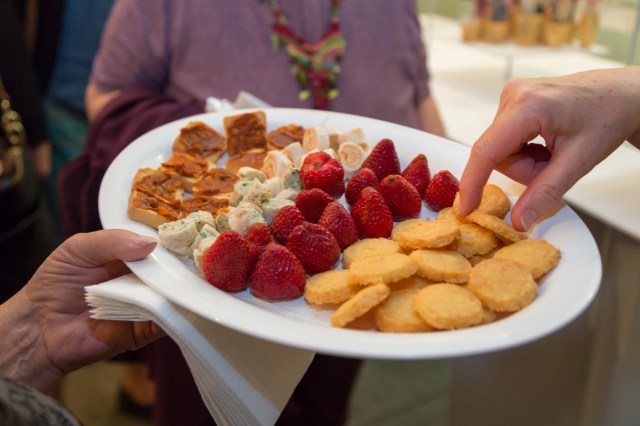
L-R: curry relish on toast; herbed, and sun dried tomato, pinwheels; strawberries; and cheese biscuits at WAFTA Altered States exhibition opening 15 September 2017. Image by Abigail Harman Photography, Perth.

Delivering our hospitality

OK, we have worked out how many nibbles, and the specific recipes, that we are preparing and delivering to the opening venue. It sounds enormous to be talking of eight dozen each of eleven recipes! It is. Believe me, though, you won’t have many left overs!

How to deliver these to guests?  It’s an option to put it all attractively on a nicely draped table as a kind of buffet.  There are three good reasons NOT to do this although I am not saying that it would never be a good idea:

  1. Guests who go to the table for a nibble are leaving the group/person they were talking to and this is disruptive and not to be encouraged.  It’s not about the food; it’s about the art appreciation and the talk!
  2. In the kind of small openings I am writing about, the involvement of servers who are often also artists is a bonus contribution to the bonhomie  and the talk about the works on exhibition; they should not be cut out!
  3. While not a big consideration, some simple hors d’oeuvres dry out rapidly and loading them onto a table to sit for a couple of hours is to condemn them to death.

So, clearly, I favour using volunteer servers at openings.  If they are the artists, all the better.  What a great opportunity for shy artists to meet their viewers!  What a good opportunity for guests to ask questions!
WAFTA Catering 4 (169) Abigail Harman

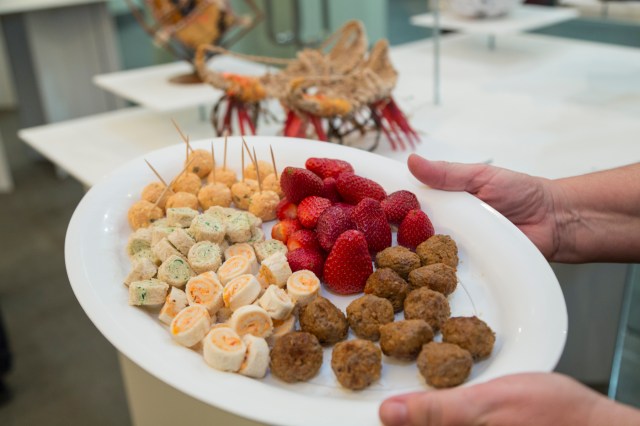
Top to bottom: Salmon balls; herb, and sun-dried tomato pinwheels; strawberries; and meatballs.  Image by Abigail Harman Photography, Perth

Pacing the service of platters

Servers hate going around with platters of food no one wants.  They are volunteers, usually, so we want them to be welcomed rather than waved away…..

The secret is to ensure they go out with their platters at the right time.  

The right time is determined by the kitchen co-ordinator.  This is the person on the catering team who oversees plating up of platters, briefs the servers on their ingredients  (GF, V, dairy free, etc), and controls the rate at which platters go out to guests.

The kitchen co-ordinator (KC) plays a vital role in the success of the event. They send out food “just in time” so that guests have enough, but not too much, food offered to them over time. They ensure that servers can answer questions about the content of different items, especially about dairy, meat and wheat content. They ensure that the available food is served fairly evenly over the entire time period scheduled for the opening so that it is still being served to latecomers who walk in close to the end.

Or to put it in more negative terms: the KC avoids pushing food to guests at too high a rate; avoids running out of food; and (hopefully) ensures no one gets sick as a result of eating something to which they are allergic.
WAFTA Catering 1(156) Abigail

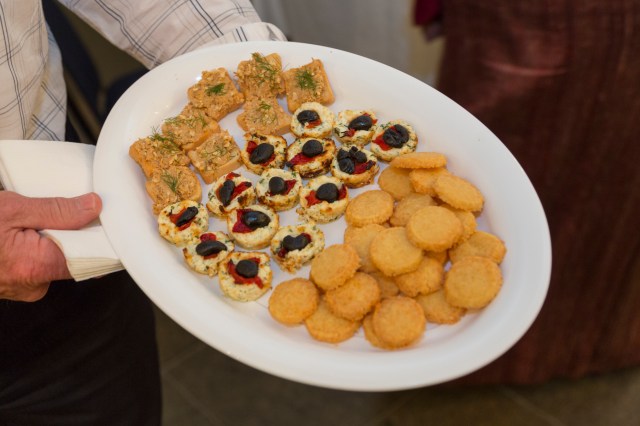
L to R: Tuna and egg spread on toast; ricotta mini-muffins; and cheese biscuits.  Image by Abigail Harman Photography, Perth

Scheduling Platters

This is only a guide for novice Kitchen Co-ordinators.  You will rapidly find that it is best tempered with judgement  based on observation of the progress of the event. Until you get there, however, and actually feel the appetite and flow of the gallery, you will want to have the backing of a formula!

To go back to our worked example, we have 8 dozen each of 11 different items,.  We want to serve them over two hours.  Consider two hours as 8 x 15 minutes.

Every 15 minutes we should be sending out 11 dozen nibbles. Think 4 platters with 33 items each on them or two platters with 66 items on each. The latter is preferred. Remember these are bite-sized nibbles! Two servers per session is easier to achieve than four!  (Of course, if in the first couple of fifteen minute periods there is only one man and dog present, you will not send out two platters!)

At this rate, with mixed platters of 66 items each going out to the exhibition crowd at the rate of two every fifteen minutes for two hours, you will serve 2x66x4x2=1056 or 88 dozen items!!! [See How Much to Make – it’s always good when the arithmetic works!]

It’s Time Gentlemen, Please!

One good thing about pacing the delivery of platters well, is that you can influence the recognition by guests of the time to go home. By ensuring more or less even distribution of platters of food throughout the evening you will have conditioned guests to that stimulus. They will recognise, consciously or unconsciously, that the platters have ceased and will be influenced to take their departure. Happily, without coercion!

So, even if you  have, as I have recommended, over-catered, let your Kitchen Co-ordinator pace distribution of platters so as to send the appropriate “lights out” signal.  You will all go to bed happy and fulfilled !!!!

Since this is the final of three parts on catering for an exhibition opening, I would like to thank again my colleagues: my friend Julie Devereux and my sister Prudence Ford.
 

WAFTA Catering 3 (165) Abigail Harman

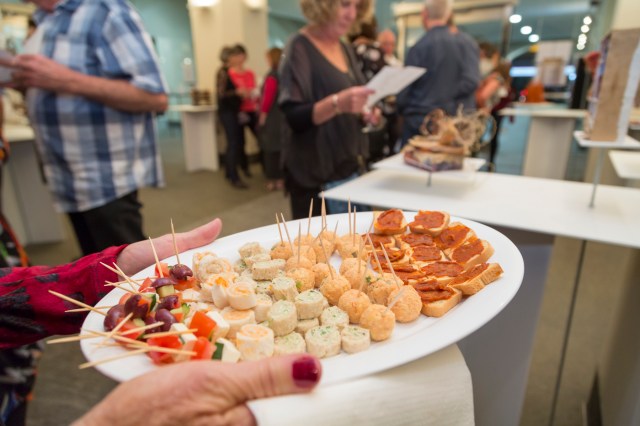
L to R: Mini Greek salads; herb, and sun-dried tomato pinwheels; salmon balls; and curry relish on toasts. Image: Abigail Harman Photography, Perth


Posted in exhibiting, Exhibition catering | 4 Comments

Exhibition Opening 2: Catering- How Much and What Not To Serve?

Thali meal Bigstock photo

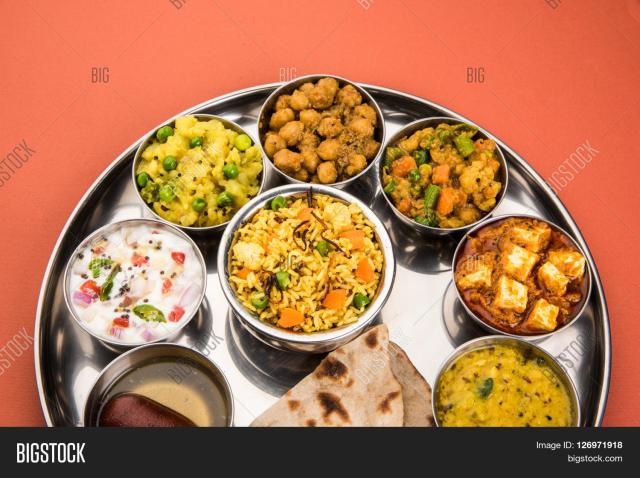
A delicious Indian Thali dish- great for a restaurant; potential disaster at an exhibition opening.

Picture this:  It’s opening night and the best art piece in the show is a long, suspended, drift of silk, painstakingly resisted with stitch, and dyed in several dye baths. As it wafts on the currents of enthusiastically breathed oohs and aahs, it brushes over an exquisitely presented platter of hommus being passed around among the guests.  Oooh!  Aaah! indeed.

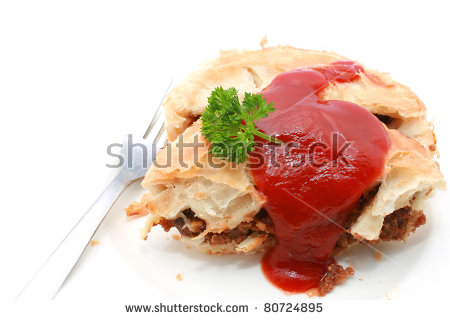
Better still, look at that party pie which has just been so extravagantly anointed with tomato sauce.  Oh, dear, it’s bled on that embroidered box…..

WAFTA AS blog stock-photo-australian-meat-pie-and-tomato-sauce-80724895

Think of the pain of realising that the excited textile loving guest (it could be you), unable to resist lightly touching a small embroidered bowl, has just finished one of those delicious, albeit greasy, crispy fried chicken wings.   And watch the fellow who leans down to look closely at the detail of a  small work just as he bites into that succulent slider whose contents promptly disgorge onto the plinth below him!

Hard to believe?  Then I reckon you’ve never been to a catered event and had it almost, if not actually, happen to you or your work! None of the people featured in the above vignettes actually intends to damage the art, of course.  Far from it.  They are at the opening because they are art lovers. But if they are given greasy or easily shattered or overly large items then accidents are entirely predictable.  Moreover, even the lucky guests who don’t cause any damage are probably distracted from their enjoyment of it all by the need to be hyper-vigilant when biting into something!

Horace food fight DSC_8512-web

Food fight: It won’t be as bad as this but it could be bad!

Fear not, however.  If the task of catering for the next exhibition opening has fallen to you and a couple of friends there is a way to do it without tears or smears.  I know because I am part of a now quite seasoned small team of three.  One is a close friend and the other is my sister. We had all done a lot of “white glove” type duties at exhibitions and shows so we got off to a good start in terms of a shared understanding of what we were up against!

Horace rules logo images

We have developed a simple set of rules about  what not to serve.  It’s so simple, in fact, that I hope it’s not insulting to you the reader:

  1. All hors d’oeuvres must be able to be put into a mouth whole; no burgers or shashliks!
  2. No dips, no sauces, no soups, no cream, no loose garnishes that can drip or fall off
  3. No wet or oily surfaces that will stay on fingers- few will go to the other end of the gallery to fetch a napkin. Even if you dispense napkins with the hors d’ouevres the “glass in the other hand syndrome” makes them difficult to use consistently..
  4. Encourage guests to place any devices such as toothpicks or small spoons back on the server’s tray immediately by providing a suitable and obvious receptacle for them
  5. Generally avoid having hot canapés as these require more planning, vigilance and management from the kitchen throughout the opening period
  6. If you must serve some  heated items, ensure they are served warm rather than hot to avoid risks of burning. This is especially a risk  with liquid (fatty or sugary) centres,
  7. Likewise, avoid nibbles that need to be served frozen or chilled as these are harder to manage correctly so they remain solid and palatable.  See Rule 2.
  8. Avoid seafoods both because of their allergy potential and because they can be a food safety risk if improperly handled.
  9. No peanuts or peanut products eg satays.  You have no way of knowing who has allergies and no guarantee that your servers will remember to tell people what is in each canapé.
  10. Have food available as soon as alcohol is poured.  If you want to delay food service until after the official proceedings finish, keep the corks in too.


Horace loaves and fishes 2

There are a lot of online and printed catering resources that will tell you how much per person to serve.  The most common guidance for a two hour cocktail type event, such as most exhibition openings,  is to allow 6-8 pieces per person.  We have found this about right.  However, we sometimes finesse it a bit.
Some factors to consider when doing your particular quantities planning are:

1. the ratio of men to women expected to attend. The smaller the proportion of men, the closer the requirement will be to 6 rather than 8.

2. we emphasise bites rather than chunkier pieces, and this reduces the total weight of food unless you  provide more per person to make up for it.  Generally, I don’t let it bother me. See 4.

3. a function held just after normal working hours finish (say, from 6pm) will result in hungrier guests than one held just after lunch. See 5.

4.the purpose of providing refreshments is to foster a relaxing and interested vibe among attendees.  It is NOT to give them dinner!

5.that said, there are advantages in over-catering a bit,  not least because it removes the anxiety of possibly not having prepared enough!  Excess production often happens naturally anyway as you prepare particular recipes and the inputs go a bit further than you originally estimated. If the opening event is really swinging and sales are going nicely it’s good to have the option of continuing the hospitality.**

**(That is, of course, provided there are no other restrictions on extending the time, such as security officers going on overtime rates after a certain hour!)

So that’s our advice on what NOT to serve and how to estimate overall quantities.  The next and final blog will pass on some tips about catering in an inclusive way for a wide variety of guests.  It will also comment on  pacing the delivery of platters and on the role of the kitchen co-ordinator in bringing the event to a conclusion!


WAFTA Catering 5 (170) Abigail Harman


Posted in exhibiting, Exhibition catering | 2 Comments

Exhibition Opening 1: should we serve food?

IMG_6686

There’s nothing like Exhibition Opening Night (or Day).

So you’re having an exhibition.  You and the other exhibitors and their supporters will have been toiling away for ages.  First you had to organise a space for the exhibition.  (that’s a whole separate blog!)

Then you all had to make the work (let’s pass over that one quickly; it’s easy, right?)

You  will have had a check list of things that MUST be done before the doors open on the exhibition:  photography; event promotion;  invitations to the opening;  curation, including props, plinths etc;  catalogue; bump-in, security……..

That’s already a lot of work.  So when someone asks:  “what are the catering arrangements for your opening?” it can be difficult to pretend you care.  Many of us will simply have our fingers crossed that there will be an  opening!  Or else we’ll be thinking “pretzels!!!”

Over the last four years I have been involved in catering for several group exhibition openings.  It’s been a wonderful learning experience which I thought I should share……

Will we feed them at all?  

There are sometimes very good reasons to decide it’s NOT necessary to feed and water (aka load up) your guests.


Horace Target-Audience-Splash

If your exhibition is aimed mainly at impressing gallery owners so you get future invitations  to exhibit at their lovely galleries, it might not be necessary to serve anything.  Busy “professional” exhibition goers are wanting to get in and out again quickly; it’s not as much a social event for them. (Apologies in advance if you are a gallery owner/manager who likes to linger over the food!)


Horace logofebmonthly-local-missions

Similarly, if your opening is scheduled for immediately after a usual mealtime, say, at 2pm on a Saturday, you can assume that attendees will have recently eaten.


Some other very practical impediments to serving food include:


Horace food safety logo stock-vector-food-safety-rubber-stamp-vector-illustration-isolated-on-white-background-379853683

.lack of space or facilities for the safe transportation, storage and/or service of food.  Some galleries have no kitchen or even a fridge.  If you have to transport food a longish way even before you get it to the gallery you will rightly be wondering if that is safe…


G-73 (3).PLT *

.food  not permitted by the gallery (although sometimes an initial prohibition can be negotiated into an agreement. Some galleries which are used to having student exhibitions are understandably cautious about committing to having to clean up afterwards.  Convincing them that you know what you are doing and will definitely leave the place cleaner than you found might be  a worthwhile effort.)


hurry up road sign illustration design

.too little time (for example, the space is only available for an hour and food and drinks would be a distraction)


Horace dollar signs.cost (in my view it’s better to spend limited funds on exhibition space, props and promotion of the whole exhibition period than on food for those who are available to attend an opening).

Hospitality is Good!!

WAFTA Catering 2 Abigail Harman

Terry Devereux serving hors d’oeuvres at the 15 September opening of WAFTA’s Altered States exhibition , 16-23 September 2017, Perth Town Hall, in front of work by Diane  Binns (left) and Janie Matthews (right) . Image by Abigail Harman, Perth.

Having said all that, if you have the time, space, permissions and money it is nice to be able to provide hospitality.  When you want your potential buyers and supportive friends to enjoy a relaxing couple of hours, and tell all their friends what a great exhibition it is, food and beverages will help enormously. Plus all the hard workers like yourselves can treat it like a well-earned opportunity to party!

Get a Caterer?

So, if the answer is “yes, we will serve food and beverages” the next step is to decide whether finances permit outsourcing to a caterer?  If you can do that you save yourself all the hassles of menu planning, quantity estimation, ensuring food safety, doing the food preparation and presentation, and organising with the venue for access and delivery.  Caterers can often handle arrangements for alcohol licensing and service too.


Horace I'm broke person-holding-i-broke-sign-studio-shot-child-made-white-paper-handwriting-48500062

However, if like many of us, your organisation or group is effectively doing this on the smell of an oily rag, you need to do the catering yourselves.


In the next blog I will outline some tips for self-catering an art  exhibition opening.


rsa logo green

One Golden Rule: if you serve alcohol then you MUST serve food with it!!


Posted in exhibiting, Exhibition catering | 1 Comment